
 中文
中文 繁體中文
繁體中文 日本語
日本語 English
 Deutsch
 Español
 Français
 العربية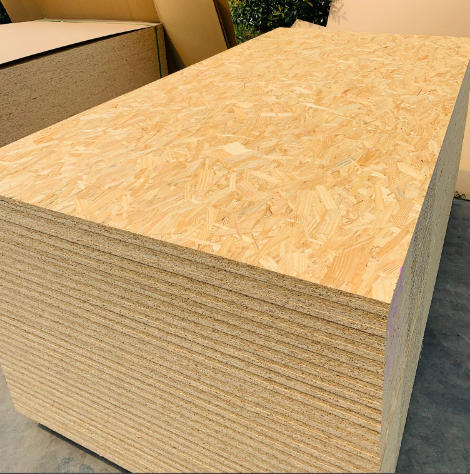
MDI Formaldehyde-Free Adhesive · ENF Eco-Friendly · High Strength · Oriented Structural Engineering Board
JINDIWOOD OSB (Oriented Strand Board) is made from small-diameter and fast-growing wood, processed through strand preparation, drying, resin blending (MDI formaldehyde-free adhesive), oriented forming, and high-temperature hot pressing. The product complies with GB/T 41715-2022 national standard and offers excellent performance: formaldehyde-free, high strength, strong screw-holding capacity, and dimensional stability. It is an ideal structural board for wood-frame construction, furniture manufacturing, interior decoration, and industrial packaging.
Core Advantages
-
Formaldehyde-Free & Eco-Friendly: Uses MDI (isocyanate) formaldehyde-free adhesive, contains no formaldehyde, and reaches ENF grade (≤0.015 mg/m³).
-
Oriented Structure, Outstanding Strength: Strands are oriented in layers; the longitudinal/transverse strength ratio is controllable. Longitudinal modulus of rupture reaches 28–40 MPa.
-
Extremely Strong Screw Holding: Face screw-holding capacity reaches 1200–1600 N, 2–3 times that of ordinary particleboard, ensuring firm and reliable connections.
-
Dimensional Stability, Deformation-Resistant: Linear expansion coefficient is about 1/2 that of ordinary particleboard, with low thickness swelling rate.
-
Complete Grades: OSB/1, OSB/2, OSB/3, and OSB/4 available, covering all scenarios: dry/humid, non-load-bearing/heavy-duty.
-
Complete Specifications: Thickness 6–40 mm, standard size 1220 × 2440 mm, customization available.
Main Applications
Roof panels, floor panels, wall panels, and I-joist webs for wood-frame construction; load-bearing furniture shelves, bookshelf dividers, cabinet side panels; interior feature walls and wall panels; heavy-duty packing crates, pallet deck boards, etc.
Customization & Services
-
OEM/ODM customization supported; minimum order quantity: 1 pallet.
-
3 own factories; annual output over USD 100 million; exporting to 20+ countries.
-
Full After-Sales Guarantee: For quality issues, no discounts—100% compensation.
Contact us for a quotation or samples.
📞 +86-0539-3198222 / +86-13145499135
📧 [email protected]
JINDIWOOD · Engineered for Certainty — With oriented structure and formaldehyde-free eco-friendliness, we provide a certain quality foundation for the strength and health of buildings and furniture.
FAQ
Q1: What is the difference between OSB and ordinary particleboard?
A: OSB uses an oriented forming structure—surface strands are aligned longitudinally, and core strands are aligned transversely, forming a cross-grained mechanical structure. Its strength is far higher than ordinary particleboard. Additionally, OSB typically uses MDI formaldehyde-free adhesive, reaching ENF grade, while ordinary particleboard mostly uses urea-formaldehyde adhesive.
Q2: What is the eco-friendly grade of OSB? Is it really formaldehyde-free?
A: JINDIWOOD OSB uses MDI (isocyanate) formaldehyde-free adhesive. The adhesive itself contains no formaldehyde and does not release formaldehyde after curing. The eco-friendly grade reaches ENF (≤0.015 mg/m³). Look for the “MDI formaldehyde-free adhesive” label.
Q3: Can OSB be used in humid environments?
A: Yes, but the correct grade must be selected. OSB/3 and OSB/4 are specifically designed for humid environments. The polyurethane network formed after MDI adhesive curing is highly resistant to hydrolysis, making it suitable for exterior walls, basements, high-humidity workshops, etc. However, long-term direct water immersion should be avoided.
Q4: How is the screw-holding capacity of OSB?
A: The screw-holding capacity of OSB is significantly better than ordinary particleboard. Face screw-holding capacity reaches 1200–1600 N, 2–3 times that of ordinary particleboard. It is recommended to install fasteners on the panel face and avoid panel edges as much as possible.
Q5: Can OSB be used for furniture manufacturing?
A: Yes. Due to its excellent mechanical properties and unique decorative effect, OSB is increasingly used in furniture manufacturing. It is suitable for load-bearing shelves, bookshelf dividers, cabinet side panels, etc. After sanding or facing, it can be used directly for visible furniture components.
Q6: OSB surface is rough. How should it be finished?
A: Raw OSB has a certain surface roughness (Ra about 8–15 μm). For a smooth surface, choose sanded OSB (Ra ≤ 3.2 μm) or faced OSB (melamine paper, wood veneer, or paint coating). JINDIWOOD offers multiple surface treatment options.
Q7: What is the MOQ and lead time?
A: MOQ is 1 pallet. Standard products: 15–30 days after order confirmation. Customized products: 20–40 days after sample confirmation.
Q8: What is your after-sales policy?
A: We offer a Full After-Sales Guarantee. If a quality issue is confirmed, we provide 100% compensation and cover replacement shipping costs—no discounts, no deductions.