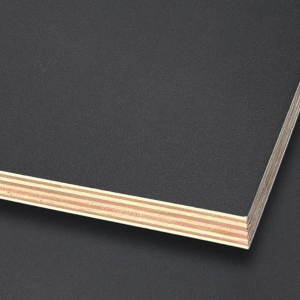
If you are sourcing melamine faced particleboard (also called MFC board, double-faced board, or eco board) from China, this guide gives you a practical framework. No fluff. Just how to look, how to choose, and how to avoid the common traps.
1. First, Know What You Are Buying
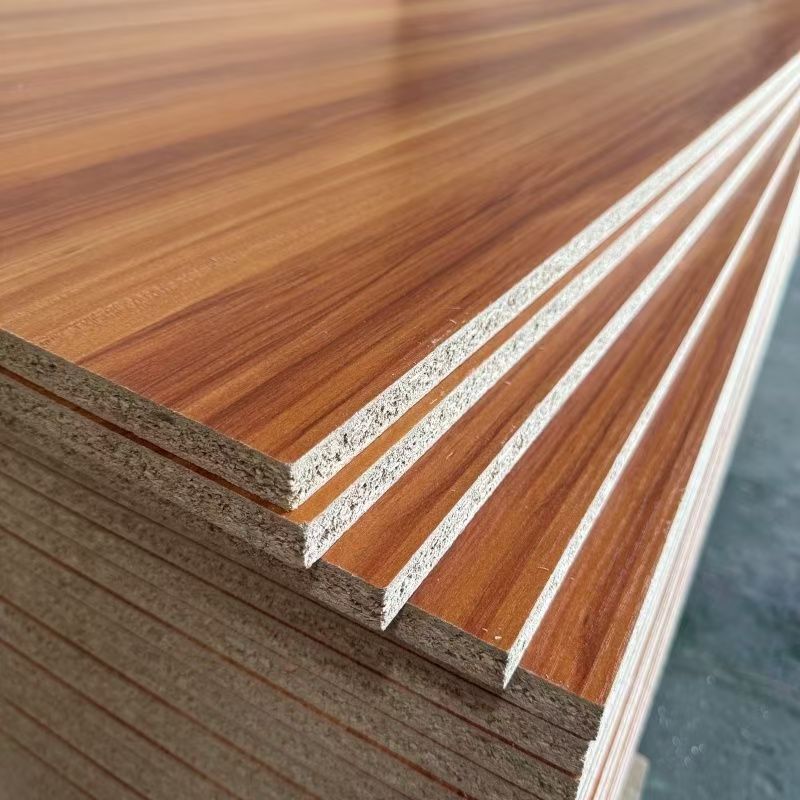
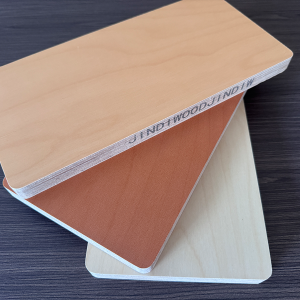
Melamine faced particleboard = particleboard core + melamine impregnated decorative paper, bonded under high temperature and pressure. The surface is already finished. No painting or laminating needed. You can cut, drill, and edge band it directly. It is used for cabinet bodies, shelves, wardrobes, office desks, and other panel furniture.
One key point: the melamine paper is only the surface layer. The core determines the performance. If the core is wrong, the prettiest surface is useless.
2. How to Choose the Core
Particleboard cores come in several grades. International buyers mostly encounter:
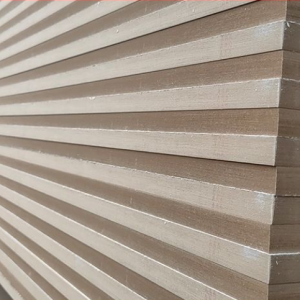
How to identify moisture resistant board: look at the cross-section. A true moisture resistant particleboard has independent green particles, evenly distributed, while the surrounding wood chips keep their natural color. If the whole cross-section is uniformly green with no independent particles, it is a fake colored with green pigment. It does not resist moisture, and formaldehyde may be higher. A more reliable method: cut a small piece and soak it in water for 1-2 hours alongside a standard board. The one that swells noticeably less is the true moisture resistant board.
How to judge density: ask the supplier for a density test report. The Chinese standard requires a density range of 0.65-0.90 g/cm³. Low density means a light board, poor screw holding, and hinges that loosen easily. Weigh it, tap it: a dense board sounds dull, a loose one sounds hollow.
3. How to Judge the Melamine Paper Surface
The quality of the decorative paper directly determines durability.
Grammage: standard decorative paper is 70-90 g/m². Below this range, the paper is too thin, and after pressing it can show through, especially on light colors. Resin content is usually 120-150 g/m² (face paper) and 80-120 g/m² (back paper).
Surface abrasion resistance: classified from AC1 to AC5. AC1 is the weakest, AC5 the strongest. Furniture cabinets generally use AC3. Tabletops and countertops should use AC4 or above. Ask the supplier for an abrasion cycle report.
Visual inspection: check the sample under natural light and artificial light. A premium product should have no dry spots, wet spots, stains, scratches, pressure marks, show-through, blisters, color unevenness, paper tears, or edge chips. Touch the surface: it should be smooth and uniform, with no burrs or grooves.
Heat and stain resistance: the decorative paper should reach heat resistance level 1 and light fastness ≥ 6. You can ask for test reports on cigarette burn resistance and stain resistance.
4. Edge Banding: The Most Overlooked Critical Step
This is where many buyers get burned. A real case: a batch of melamine faced particleboard shipped to a hotel in Dubai. On arrival, the surface was perfect. Within 60 days after installation, 12% of the boards had swollen edges. The cause: edge banding too thin, wrong glue. Moisture penetrated through the edge seams and swelled the core. Emergency air freight for replacement boards cost over USD 18,000.
Edge banding key points:
-
Thickness: 0.4 mm or 0.8 mm are common. For kitchens and humid environments, use 0.8 mm or above.
-
Material: PVC is mainstream. ABS is tougher but more expensive.
-
Glue: EVA is cheap but has average water resistance. PUR is better for water and heat. Kitchen and bathroom cabinets must use PUR.
-
Color matching: the edge banding color must match the melamine paper. A large color difference will be obvious on the finished cabinet edges.
Before ordering, confirm the edge banding specifications, not just the board itself.
5. Formaldehyde Grade: Choose According to Your Target Market
The formaldehyde grade is not about "higher is better." You need to choose the right standard for your target market.
Key information:
EU new rule: from August 2026, the EU E1 limit tightens to 0.062 mg/m³ (E1-EF). Make sure your supplier can meet the new standard.
US market: melamine faced particleboard entering the US must comply with CARB ATCM Phase II or EPA TSCA Title VI. The formaldehyde emission limit for particleboard is 0.09 ppm. Import requires TSCA Section 13 import certification. The product must be certified by an EPA-recognized third-party certifier (TPC) and carry the TSCA Title VI compliance label.
Chinese standard: GB/T 39600-2021 classifies formaldehyde emission into E1, E0, and ENF. ENF ≤ 0.025 mg/m³ is currently the strictest.
How to verify: do not rely only on the supplier's own report. Ask for a report from a third-party lab such as SGS, Intertek, or TÜV. Check that the standard number and limit on the report match your target market requirements.
6. Dimensional Tolerances and Physical Performance
Thickness tolerance: high-quality melamine faced particleboard should be controlled within ±0.3 mm. If the tolerance is too wide, joints are uneven, and finished cabinets show obvious gaps.
Density deviation: within-board density deviation should be ≤ ±3%. If density is uneven, screw holding varies across the same board.
Moisture content: 5%-8% is ideal. Too high, and it deforms after machining. Too low, and it may absorb moisture during shipping.
Screw holding: face screw holding is usually higher than edge screw holding. Hinges, slides, and other hardware should be installed on the face whenever possible. If edge installation is necessary, use inserted nuts or special connectors.
Static bending strength: ≥ 13 MPa is a common requirement. It affects the load capacity of shelves.
7. Factory Audit and Sample Testing Checklist
What to look for in a factory audit:
-
Press type: continuous press (CPS) produces better density uniformity than multi-daylight press.
-
Decorative pressing line: stable temperature, pressure, and time. Normal pressing temperature 160-200°C, pressure 25-35 kg/cm², time 30-60 seconds.
-
Lab: internal bond strength tester, formaldehyde testing equipment, abrasion tester.
-
Warehouse: raw material brand, grade, and storage conditions.
Must-do sample tests:
-
Boil for 2 hours, check if edges delaminate.
-
Scratch the surface hard with a key or coin, check for obvious marks.
-
Cut a small piece and soak for 24 hours, measure thickness swelling. Standard board ≤ 15%, moisture resistant ≤ 8%.
-
Drive screws into the face and edge, test screw holding.
-
Look at the sample under strong angled light, check for waves, blisters, or color differences.
8. What Must Be Written in the Contract
The following clauses should be written into the purchase contract item by item:
-
Core grade (standard/moisture resistant) and density range
-
Decorative paper grammage and surface abrasion grade
-
Edge banding material, thickness, and glue type
-
Formaldehyde grade and corresponding test standard (EN 717-1 / CARB / TSCA Title VI / GB/T 39600)
-
Thickness tolerance (±0.3 mm recommended)
-
Batch-to-batch color difference control (ΔE ≤ 1.5 recommended)
-
Handling of non-conforming products: full compensation or replacement, who pays replacement shipping
-
Lead time and delay responsibility
Frequently Asked Questions (FAQ)
Q1: Are melamine faced particleboard, no-paint board, and eco board the same thing?
A: They are basically different names for the same type of product. No-paint board, eco board, double-faced board, MFC board all refer to particleboard or MDF with melamine decorative paper pressed on the surface. Different names, same core process.
Q2: Particleboard core or MDF core, which one?
A: Particleboard is more cost-effective, suitable for cabinet bodies and shelves. MDF has a finer internal structure, suitable for door panels and decorative panels that require fine machining or profiling. Switching from particleboard core to MDF core usually increases unit cost by about 18%.
Q3: How much price difference between moisture resistant and standard board?
A: Moisture resistant board contains moisture resistant particles and special glue, usually 10%-20% more expensive than standard board. Kitchen and bathroom cabinets should use moisture resistant board. Standard board is fine for normal bedroom cabinets.
Q4: How many years can melamine faced particleboard last?
A: In a normal dry indoor environment, quality products last 8-15 years. In humid environments like kitchens and bathrooms, if edge banding is not done properly, the lifespan drops significantly. Edge banding quality affects actual service life more than the board itself.
Q5: What is the usual MOQ?
A: Most Chinese factories have a regular MOQ of 1×40ft container, about 800-900 sheets (based on 18 mm, 1220×2440 mm). Trial orders can be 1 pallet, but the unit price will be higher.
Q6: What is the usual lead time?
A: Regular colors and specifications, 15-30 days. Custom colors or special specifications, 30-45 days. Peak season (August-November), book earlier.
Q7: How to tell if a supplier's formaldehyde report is real?
A: Three methods. First, check that the standard number and limit on the report match your target market. Second, require the report to come from an internationally recognized third-party lab such as SGS, Intertek, or TÜV, not the factory's own lab. Third, for large volumes, arrange your own third-party spot testing. The cost is not high, but it avoids the risk of a full container return.
Q8: What is the difference between AC3 and AC4 abrasion grades?
A: AC3 is for vertical surfaces or low-wear areas such as cabinet bodies and shelves. AC4 is for horizontal surfaces such as tabletops and countertops, with higher abrasion cycles. Choose too low, and the tabletop will be scratched within six months.

 中文
中文 繁體中文
繁體中文 日本語
日本語 English
 Deutsch
 Español
 Français
 العربية